
2026. 2. 27. 10:50ㆍ회원작품 | Projects/Education
National Forest Welfare Education Center

목구조의 유형제안, 코로나
산림복지종합교육센터는 파일럿 프로젝트로서의 위상을 갖는다. 건축법에서 목조건축의 층수 제한 항목 삭제에 따라 국내 최초 목조 7층 건축물을 실현함에 있어 상징성과 함께 새로운 다층·대형목조건축에 적용될 디자인 가이드라인의 정립이 필요했다. 제안공모 당시 본관동(업무), 교육동(교육), 숙박동(주거), 근린생활시설(판매)까지 총 4가지 유형으로 구분하고 각 시설의 특성에 맞는 목조 구법의 차이를 통해 도시목질화를 위한 유형을 제안했다. 기본계획 수립 시 374억 원의 예산으로 4개동 건립을 목표로 하였으나, 코로나로 인해 원자재 가격 상승이 맞물려, 불가피하게 본관동·교육동 2개로 축소설계 되었으며, 발주처의 노력으로 추가예산을 확보하면서 숲속도서관까지 총 3개동으로 준공했다.
배치_‘자연과 도시의 회복탄력성’
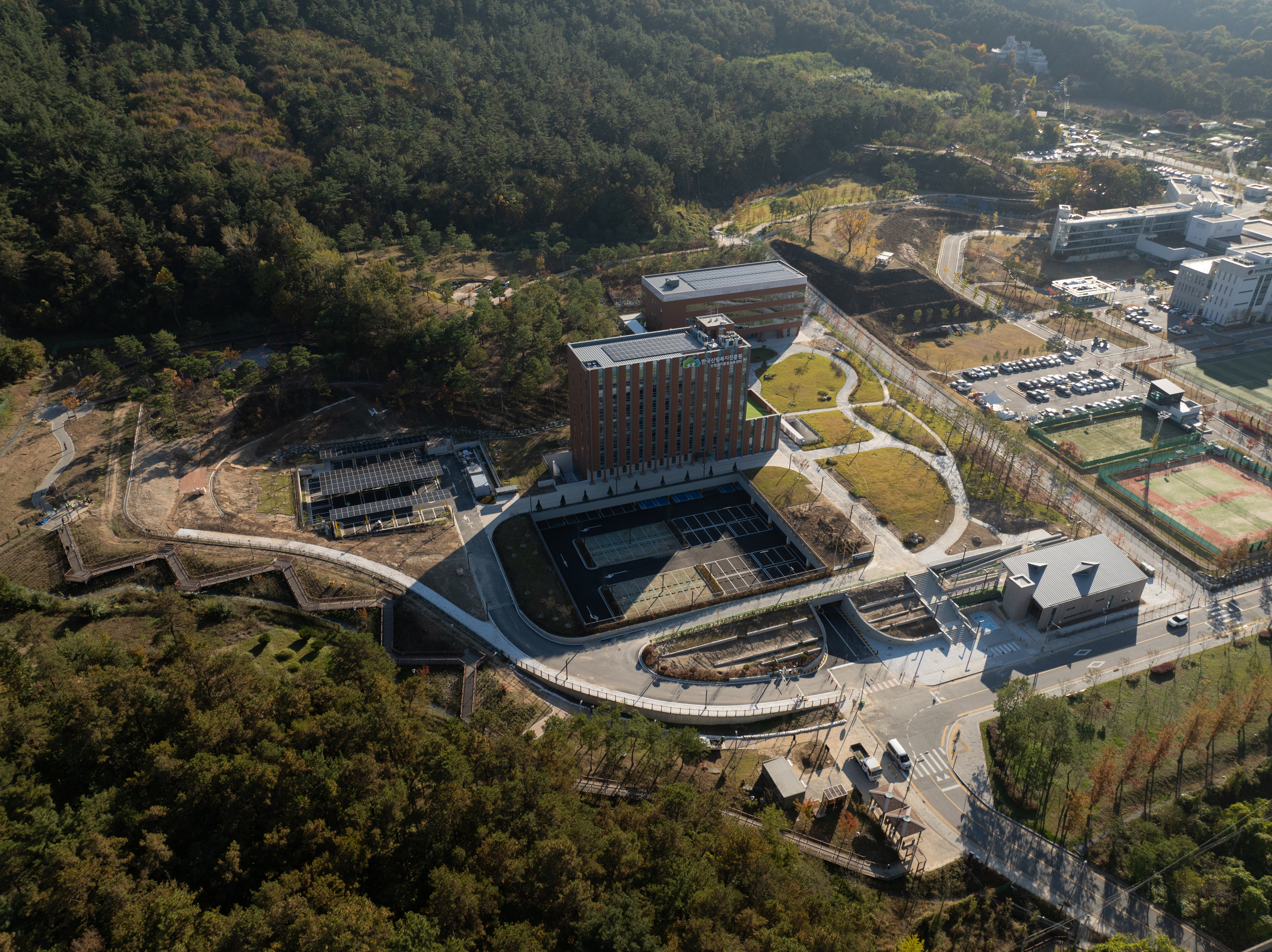
산림복지종합교육센터는 우리 시대의 사회적, 환경적 변화에 능동적으로 대처하면서 진화하는 리질리언트 시스템(resilient system)을 바탕으로 지속가능한 방식으로 작동한다. 대지는 구봉산 자락 신설되는 도시공원과 경계를 이뤘다. 지난 시대의 개발 방식은 성절토를 통해 평평한 가용지를 극대화하고, 건물을 후면 배치하는 방식으로 자연을 단절시키는 방식이었다. 산림복지종합교
육센터는 산자락의 자연스러운 굴곡을 대지 안으로 끌어들이고, 건물의 뒤(남쪽)에 충분한 오픈스페이스를 둠으로써 자연과 도시 사이의 경계의 의미를 재해석하고자 했다. 대지계획에 있어서 기후중립적인 건물계획과 더불어 미래사회가 지향하는 회복탄력적 계획을 반영했다.
목질화(木質化)를 위한 유형적 접근
목조건축을 확산시키기 위한 당대의 노력은 목조가 어떠한 특수성을 갖는가에 초점이 맞춰져 있었다. 목조건축이 도시의 일상적인 건축제로 적용되기 위해서는 건축의 재료와 공법으로서 갖는 보편성을 증명해야 한다. 이 두 가지 관점을 통합하는 것이 유형적 접근이다. ‘유형’은 어떤 현상의 공통적 성질을 형상으로 나타내며, ‘추상적인 보편성과 개별적인 구체성’이 통일되어 있는 것에 이르기 때문이다.
목구조의 다양한 유형과 구조설계
TYPE 1 : Office_본관동(2시간 내화)
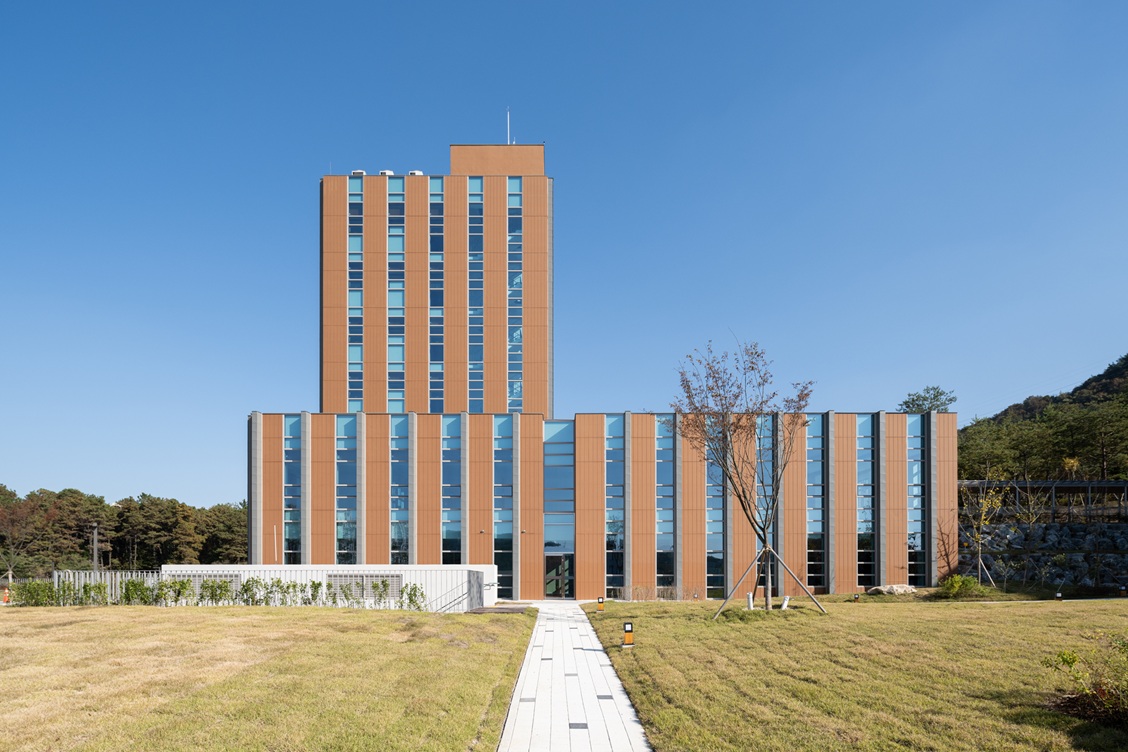
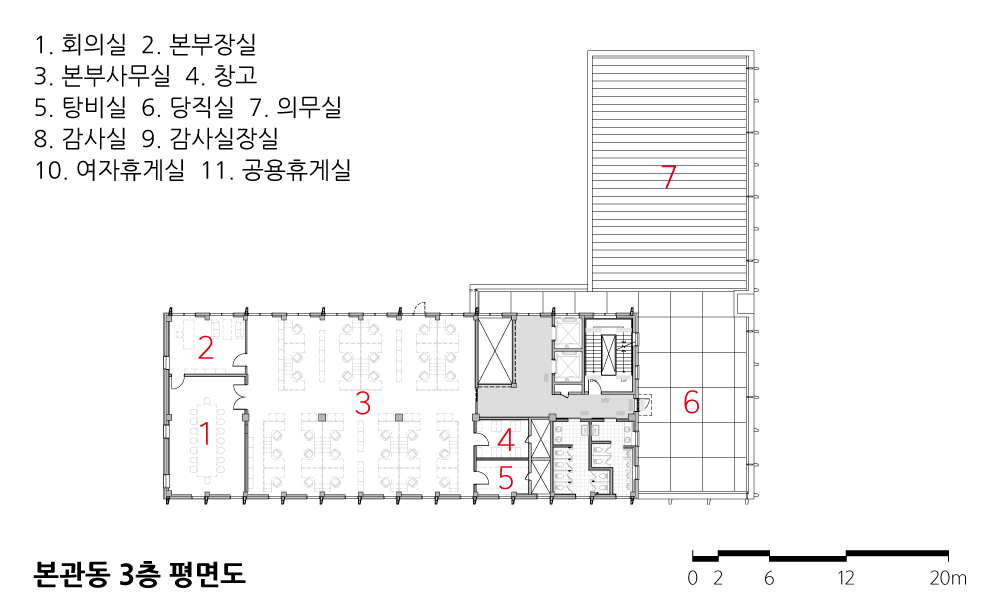
도시건축을 이루는 첫 번째 유형은 업무시설이다. 업무공간을 위한 합리적인 모듈과 가변성을 갖는 구조시스템으로 구성된다. 수직과 수평의 반복적 모듈을 적용하고 RC코어와 CLT벽체로 횡력을 보강했다. 목재는 구조재이면서 마감재로 사용되는데 근대 오피스의 이성적인 공간구성을 성취하면서 친근한 분위기를 형성한다.
TYPE 2 : Education_교육동(1시간 내화)
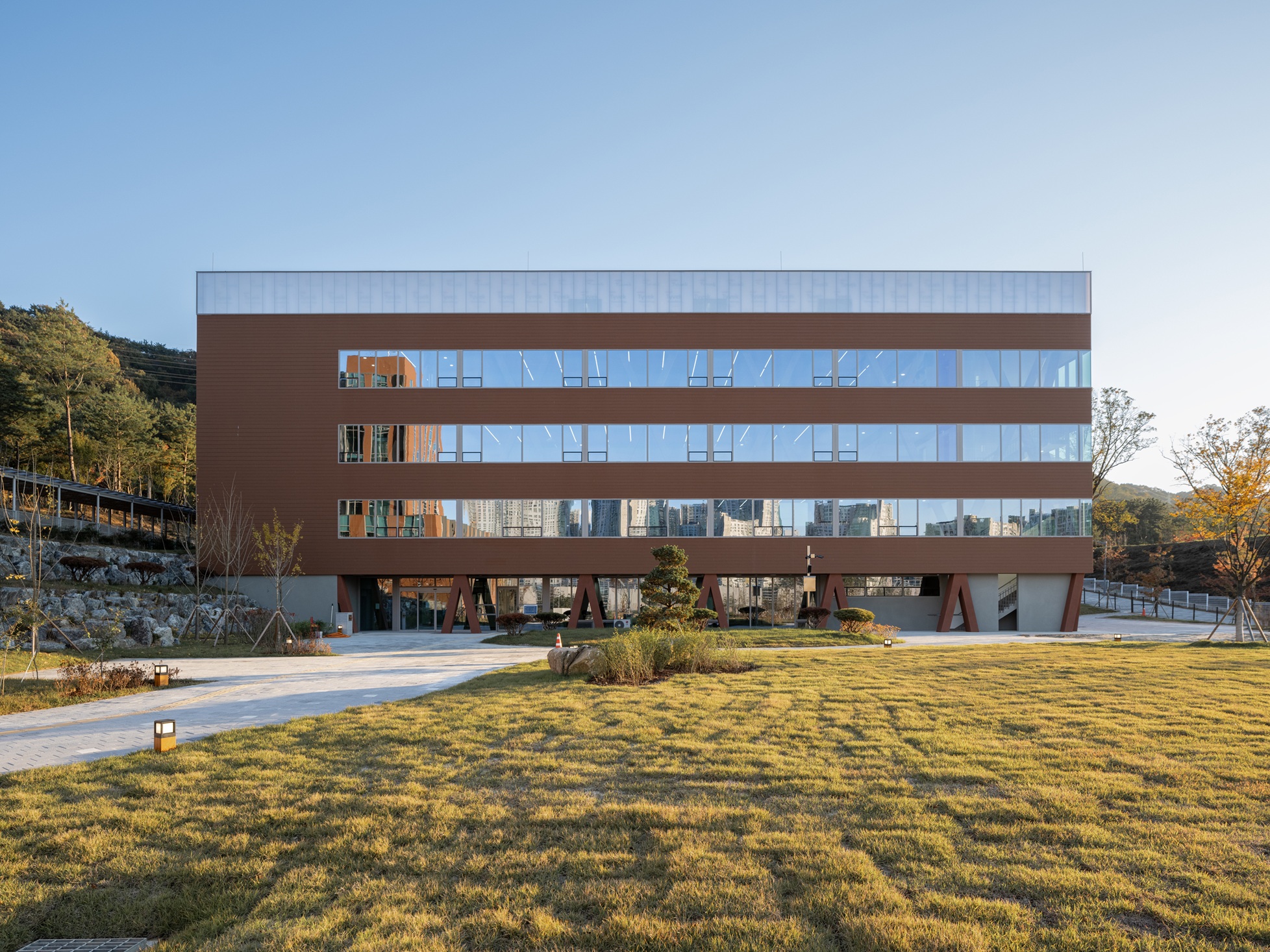
문화와 교육시설은 도시건축에서 연속적이기보다는 오브제로써 장소적 특징을 갖는다. 균질한 활동이 아닌 다양한 종류의 활동을 담는 보자기와 같은 공간이다. 강의실부터 강당까지 다양한 크기의 공간을 포용하는 구조형식이 적용된다. RC코어와 사선기둥을 통해 별도 보강 없이 횡력에 저항하는 구조시스템이다.
TYPE 3 : Community_숲속도서관
숲속도서관은 대지에 반응하는 두 가지 태도에 의해 만들어진다. 대지의 특성을 재현하는 철근콘크리트와 대지를 존중해 그것으로부터 들어 올려진 목구조로 구성된다. 건축과 책, 사람의 활동이 연속적으로 통합이 이루는 풍경을 만들며, 도서관으로 명명하지만 카페이기도 하고, 명상의 공간이며, 숲과 관련한 프로그램이 운영되는 집회장이기도 하다. 우측의 구봉산으로 오르는 보행전용로와 맞닿아 주민들의 쉼터로도 활용된다. 공간의 개방감을 위해 지붕장선보에 스틸과 목재가 혼합되는 하이브리드 구조를 적용했다.


A Typological Proposal for Timber Architecture in the Post-COVID Era
The Forest Welfare Comprehensive Education Center holds the status of a pilot project. With the removal of height restrictions on timber buildings in the Korean Building Act, the project realized the nation’s first seven-story timber building. Beyond its symbolic significance, the project required the establishment of new design guidelines applicable to future multi-story and large-scale timber architecture.
At the competition stage, the program was organized into four building types: the Main Office Building (office), the Education Building (education), the Accommodation Building (residential), and a Neighborhood Facility (retail). By applying different timber construction systems suited to the characteristics of each program, the project proposed a typological approach toward urban timberization.
The initial master plan aimed to construct all four buildings with a budget of KRW 37.4 billion. However, due to a tightly constrained initial budget and rising material costs during the COVID-19 pandemic, the project was inevitably reduced to two buildings—the Main Office and Education Buildings. Later, through the client’s efforts to secure additional funding, a third building, the Forest Library, was added, resulting in the completion of three buildings in total.
Site Planning: Resilience Between Nature and City
The Forest Welfare Education Center operates as a resilient system that evolves in response to the social and environmental changes of our time, functioning in a sustainable manner. The site borders a newly developed urban park at the foothills of Mt. Gubong.
Past development practices often maximized flat buildable land through excessive cutting and filling, placing buildings at the rear of the site and severing connections with nature. This project reinterprets the boundary between nature and the city by drawing the natural contours of the mountain into the site and securing generous open space behind the buildings on the southern side.
Along with climate-neutral building strategies, the site plan reflects a resilient planning approach oriented toward future society.
A Typological Approach Toward Urban Timberization
Previous efforts to expand timber architecture have largely focused on the material’s unique characteristics. However, for timber construction to be widely adopted as an everyday urban building method, its universality—as both material and construction system—must be demonstrated. The typological approach integrates these two perspectives.
A “type” represents the shared characteristics of a phenomenon in a formalized way, where abstract universality and concrete specificity are unified. Through this lens, the project explores how timber architecture can become a standard component of urban building practice.
Structural Design and Timber Typologies
TYPE 1: Office – Main Office Building (2-hour fire resistance)
The first typology of urban architecture addressed is the office building. This type is composed of a rational modular system and a flexible structural framework suited to office use. Repetitive vertical and horizontal modules were applied, while lateral forces were reinforced through an RC core and CLT shear walls.
Timber is used both as a structural and finishing material, achieving the rational spatial order of the modern office while
creating a warm and approachable atmosphere.
TYPE 2: Education – Education Building (1-hour fire resistance)
Cultural and educational facilities function less as continuous urban fabric and more as objects with distinct placeness. Like a wrapping cloth, this building accommodates diverse activities rather than a single uniform function. A structural system capable of encompassing spaces of various scales—from classrooms to an auditorium—was applied. Lateral stability is achieved through an RC core and inclined columns, without the need for additional reinforcement.
TYPE 3: Community – Forest Library
The Forest Library is shaped by two contrasting responses to the site. One is a reinforced concrete structure that reflects the site’s characteristics; the other is a timber structure lifted from the ground in respect for the terrain. The building creates a landscape where architecture, books, and human activity are continuously integrated.
Although named a library, the space also functions as a café, a place for meditation, and a venue for forest-related programs. Adjacent to a pedestrian path leading up Mt. Gubong, it serves as a resting place for local residents. To enhance spatial openness, a hybrid structural system combining steel and timber was applied to the roof joists.
This project remains an ongoing task—one that continues to explore and refine the future possibilities of large-scale, multistory timber architecture.


| 산림복지종합교육센터 설계자 | 최삼영 건축사_ (주)가와 종합건축사사무소 조남호 건축사_ (주)솔토지빈 건축사사무소 건축주 | 한국산림복지진흥원 감리자 | (주)신화엔지니어링 종합건축사사무소, (주)신성 종합건축사사무소 시공사 | 목구조 _ (주)경민산업 / 일반 _ (주)해송건설 설계팀 | 가와건축 _ 최우진, 김규섭, 강민수, 장명준 솔토건축 _ 임기웅, 임수지, 이신후, 김건 설계의도 구현 | (주)가와 종합건축사사무소, (주)솔토지빈 건축사사무소 대지위치 | 대전광역시 서구 관저동 주요용도 | 교육연구시설(업무공간, 교육 및 연수공간, 야외체험 교육공간) 대지면적 | 26,665.40㎡ 건축면적 | 2,157.33㎡ 연면적 | 9,938.24㎡ 건폐율 | 8.09% 용적률 | 25.63% 규모 | 본관동 _ B1F - 7F / 교육동 _ B1F - 3F / 숲속도서관 _ 2F 구조 | 목구조(중목+경목) / 철근콘크리트구조 외부마감재 | 시멘트 랩사이딩, 탄화우드사이딩 내부마감재 | 방화석고 위 도장, 목재흡음패널, 목재사이딩, 시멘트사이딩 설계기간 | 2020. 07 - 2021. 06 공사기간 | 2022. 01 - 2024. 10 사진 | 김용수 구조분야 | (주)환구조기술사사무소, (주)금나구조기술사사무소 기계설비분야 | (주)동남엠이씨 전기분야 | (주)대경전기설계사무소 소방분야 | (주)동남엠이씨, (주)대경전기설계사무소 |
National Forest Welfare Education Center Architect | Choi Samyoung / Kawa Architects & Design Cho Namho / Soltozibin Architects Client | Korea Forest Welfare Institute (FOWI) Supervisor | Shinhwa Engineering Architecture / Shinsung Architects & Engineering Associates Co., Ltd Construction | Kyung Min Industrial. Co., Ltd Project team | Kawa _ Choi Woojin, Kim Gyuseop, Kang Minsoo, Jang Myeongjun Solto _ Lim Kiwoong, Im Suji, Lee Shinhoo, Kim Geon Design intention realization | Kawa Architects & Design Location | Gwanjeo-dong, Seo-gu, Daejeon Program | Education and research facilities (workspaces, education and training spaces, outdoor experiential education spaces) Site area | 26,665.40㎡ Building area | 2,157.33㎡ Gross floor area | 9,938.24㎡ Building to land ratio | 8.09% Floor area ratio | 25.63% Building scope | Main Building _ B1F - 7F / Education Building _ B1F - 3F / Forest Library _ 2F Structure | Timber Structure (Heavy Timber Construction + Light Frame Construction) / RC Exterior finishing | Cement lap siding, Carbonized wood siding Interior finishing | Fireproof plaster overlay, Wood sound-absorbing panels, Wood siding, Cement siding Design period | Jul. 2020 – Jun. 2021 Construction period | Jan. 2022 – Oct. 2024 Photograph | Kim Yongsu Structural engineer | Hwan Structural Engineering Co., Ltd. / Geumna Structural Engineering Co,. Ltd. Mechanical engineer | Dongnam MEC Co., Ltd. Electrical engineer | Daekyeong Electric Design Office Co., Ltd. Fire engineer | Dongnam MEC Co., Ltd. / Daekyeong Electric Design Office Co., Ltd. |


'회원작품 | Projects > Education' 카테고리의 다른 글
| 주례열린도서관 2025.12 (0) | 2025.12.31 |
|---|---|
| 인천대학교 제2도서관 _ 이룸관 2025.12 (0) | 2025.12.31 |
| 현대자동차그룹 영남권 교육시설 2025.12 (0) | 2025.12.31 |
| 신나는학교 기숙사 및 급식소 2025.11 (0) | 2025.11.28 |
| 시흥 해양생태과학관 2025.11 (0) | 2025.11.28 |